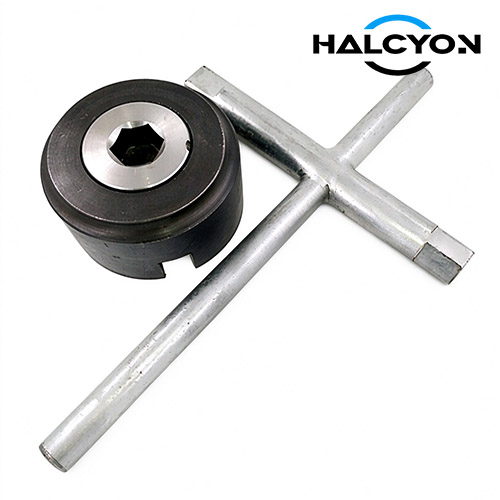
Spanner for Marine Hexagon Bottom Plug
This spanner is a dedicated marine hand tool specially designed for installing, tightening and removing marine hexagon bottom plugs. Precision-machined to match the hex profile of bottom plugs, it delivers stable torque transfer and avoids slipping or damaging the plug head.
Overview
The challenge in removing or installing hexagonal-head bottom drain plugs lies not in the torque required, but in the tool's ability to maintain a secure grip. These plugs often sit submerged in oily bilge water for extended periods; rust and scale buildup can round off their edges, causing open-end wrenches to slip the moment force is applied. This slippage further rounds the edges, eventually rendering the plug impossible to remove. A specialized wrench for these plugs solves this problem by using a hexagonal socket that fully encloses all six sides, distributing torque evenly across the faces rather than concentrating it on just two corners.
What distinguishes a high-quality hexagonal plug wrench?
Socket depth is the first key factor. If the socket is too shallow, it grips only the upper part of the plug head, resulting in insufficient contact area; if it is too deep, it may interfere with the ship's bottom structure, preventing it from fitting over the plug. An optimal depth covers the full height of the plug head while allowing an extra 2–3 mm of clearance.
Wall thickness determines the tool's lifespan. Since the hexagonal socket bears force on all six sides, insufficient wall thickness makes it prone to cracking at the corners. For 316L stainless steel tools, the wall thickness should be designed at 1.2 to 1.5 times the plug's "across-flats" dimension.
Handle angle affects usability. Working space at the bottom of the hull is often limited to a height of just a few dozen centimeters; a straight-handled wrench might strike the hull structure before completing even half a turn. Certain sizes require bent or offset handles to provide sufficient clearance for the hand to swing.
The difference in hardness between the tool and the plug is equally critical. The working end of the wrench must be harder than the plug head; otherwise, when attempting to remove a seized plug, the socket may deform before the plug does. This not only ruins the tool but can also cause the plug head to become jammed inside the socket.
When is a hexagonal socket required instead of a square socket?
Both square-head and hexagonal-head drain plugs are used in marine bottom drainage systems; the choice of tool depends on the specific design of the plug itself. Hex-head threaded plugs are commonly found in the following locations:
End plugs in bilge water discharge piping systems; the standard hex head allows for emergency operation using common tools.
Bottom drain ports on imported shipboard equipment; these feature hex heads configured according to the original manufacturer's standards.
Drain plugs located beneath the manhole covers of ballast and oil/water tanks; the hex head design facilitates access from the side.
The common feature of these locations is that the plug head is fixed as a hexagon—square sockets will not fit, necessitating the use of a dedicated hex wrench or socket.
Practical field experience:
When removing a rusted-in hex-head plug, do not apply maximum force immediately. The correct procedure is as follows: first, clean off paint and rust scale from the plug head to expose the hexagonal faces; spray penetrating oil at the base of the plug and let it sit for at least fifteen minutes; fully seat the socket onto the head and tap the end of the wrench lightly to ensure a snug fit; then, apply force slowly—once movement is felt, gently rock the plug back and forth to allow the penetrating oil to work its way into the threads. Avoid sudden, violent wrenching throughout the process to prevent the plug head from snapping off.