Suction Bellmouth
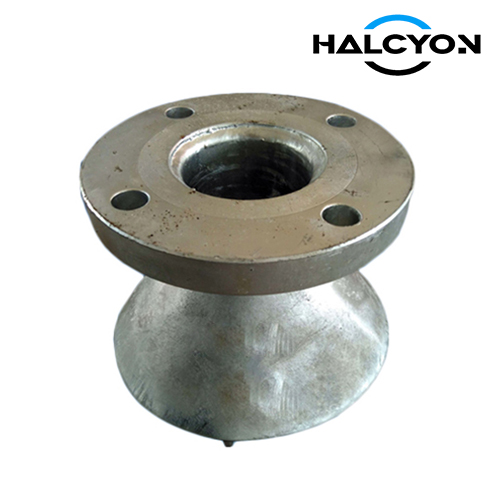
A Suction Bellmouth is a flared, trumpet-shaped pipe fitting installed at the inlet of a pump suction, tank drain, or reservoir outlet. Its smoothly expanding profile guides fluid into the pipe with minimal turbulence, reducing entrance losses and preventing the formation of air-entraining vortices. Often fitted with an integral strainer or grating, it protects downstream equipment from debris while ensuring a steady, unobstructed flow of liquid to the pump. In marine, industrial, and water treatment systems, the suction bellmouth is essential for maintaining pump efficiency, preventing cavitation, and prolonging equipment life.
Overview
1. Design Standards and Hydraulic Principles
Suction Bellmouths are designed based on established fluid dynamics principles and, where required, relevant industry standards:
Hydraulic Institute Standards (HI): Guidelines for pump suction piping, including recommended inlet configurations, minimum submergence depths, and vortex prevention measures.
ISO 5167 / ASME MFC: While primarily for flow measurement, the principles of smooth inlet convergence and velocity profile development inform bellmouth geometry.
Classification Society Rules (Marine): ABS, DNV, LR, BV, and others specify requirements for bilge, ballast, and fire pump suctions, including strainer open area and anti-vortex devices.
Flange Compatibility: Outlet flanges are available to any international standard — ANSI/ASME B16.5 (Class 150/300), EN 1092-1 (PN10/PN16), JIS B2220 (5K/10K), or GB/T 2501 — for direct integration into existing piping.
2. Material Selection for the Operating Environment
Materials are chosen based on the fluid, pressure, and environmental conditions:
Cast Iron / Ductile Iron: Economical for fresh water, seawater, and non-corrosive fluids. Internally and externally coated with epoxy or hot-dip galvanized for corrosion protection.
Carbon Steel: For higher pressure and structural applications. Protected by heavy-duty coatings.
Stainless Steel (304L / 316L): Excellent corrosion resistance in seawater, chemicals, and hygienic services. Provides a clean, maintenance-free surface.
Bronze / Gunmetal: Traditional choice for marine seawater suctions, offering inherent corrosion resistance and non-sparking properties.
Fabricated Steel (Galvanized or Coated): For large-diameter, non-standard, or site-specific installations.
3. Design Configurations and Key Features
Bellmouth Profile: The inlet expands in a radiused or elliptical flare from the pipe diameter to a larger entry diameter (typically 1.5D–2D). This shape minimizes the entrance loss coefficient (K-factor) and prevents flow separation.
Anti-Vortex Devices: When liquid level is low relative to the inlet diameter, an anti-vortex plate or cross-vane is mounted above the bellmouth. This breaks up rotational flow near the surface, preventing air from being drawn into the suction.
Integral Strainer / Guard: A perforated screen, bar grating, or mesh cover is fitted across the inlet to prevent debris, aquatic life, ice, or solids from entering the piping. The open area is sized to keep net velocity low, reducing pressure drop and clogging risk.
Mounting Options: Bellmouths can be supplied with floor stands or legs for tank-bottom mounting, wall brackets for side-entry, or flanged connections for direct pipe mounting. Stands maintain a set clearance to prevent sediment aspiration.
Flanged Outlet: A standard raised-face or flat-face flange mates with the suction pipe, drilled to the required bolt pattern.
4. Key Technical Benefits
Maximizes Pump Performance: Smooth inflow reduces required Net Positive Suction Head (NPSHr), helping to prevent cavitation and maintain stable flow.
Prevents Air Ingress: The combination of a large inlet area, adequate submergence, and anti-vortex features ensures only liquid enters the pipe, keeping the pump primed.
Protects Downstream Equipment: The integral strainer guards pumps, valves, heat exchangers, and spray nozzles from damage and blockages caused by foreign objects.
Easy to Inspect and Maintain: Bellmouths are typically positioned in accessible areas (tanks, sumps) for periodic cleaning of the strainer and removal of accumulated debris.
Long Service Life: Robust, corrosion-resistant construction requires minimal maintenance beyond occasional coating touch-up and strainer cleaning.
5. Typical Applications
Marine: Bilge and ballast pump suctions, fire pump sea chest inlets, engine room cooling water intakes, cargo pump tank suctions, and freshwater tank outlets.
Industrial Process: Cooling tower basin outlets, chilled water and condenser water pump suctions, and process tank drain lines.
Water and Wastewater: Pump station wet well intakes, reservoir and clear well outlets, and stormwater sump suctions.
Fire Protection: Suction inlets for fire pumps drawing from tanks, reservoirs, or open water.
Irrigation and Agriculture: Pump intakes from canals, ponds, and storage tanks.
6. Quality Assurance and Documentation
Dimensional Inspection: Every bellmouth is checked for flare profile, flange dimensions, strainer open area, and mounting foot clearance to the approved drawing.
Material Traceability: EN 10204 Type 3.1 material certificates (or equivalent) are provided for the bellmouth body, strainer, and anti-vortex components. Permanent marking includes size, material grade, and heat number.
Coating Inspection: Where protective coatings are applied, thickness, adhesion, and holiday testing can be performed and documented on request.
Class Acceptance (Marine): Bellmouths for shipboard use can be supplied with documentation accepted by all major IACS classification societies to support newbuilding and repair surveys.