Marine Suction Bellmouth
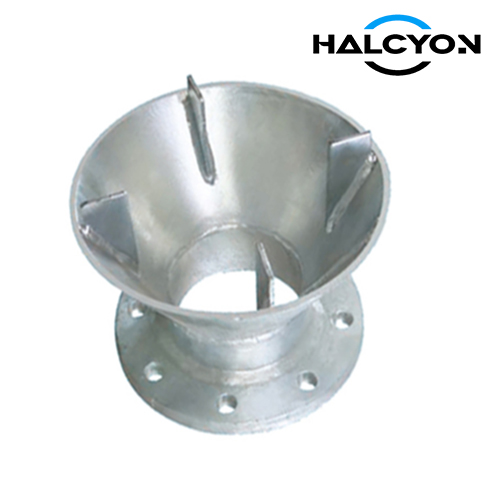
A Marine Suction Bellmouth is a flared, trumpet-shaped pipe fitting installed at the inlet end of a pump suction, tank drain, or bilge suction line. Its smoothly expanding cross-section guides fluid into the pipe with minimal turbulence, reducing flow resistance and preventing the formation of air-entraining vortices. Often incorporating an integral strainer or grating, the bellmouth prevents debris, sediment, and foreign objects from entering the piping system while ensuring the pump receives a steady, uninterrupted supply of liquid. It is a critical component for maintaining pump performance, preventing cavitation, and protecting downstream equipment throughout the vessel.
Overview
1. Applicable Standards and Design Basis
Our Marine Suction Bellmouths are designed and manufactured in accordance with relevant marine and hydraulic standards:
ISO 5167 / ASME MFC: While primarily for flow meters, the principles of flow conditioning and velocity profile shaping guide the bellmouth profile.
Hydraulic Institute Standards: Design recommendations for pump suction piping, including recommended minimum submergence to avoid vortexing, inform the bellmouth diameter and geometry.
Classification Society Rules: ABS, DNV, LR, BV, CCS, NK, KR, RINA, and others specify requirements for bilge and ballast suction intakes, including the fitting of strainers and the minimum open area.
Flange Compatibility: Outlet flanges are drilled to match any international standard — DIN EN 1092-1 (PN6/PN10/PN16), JIS B2220 (5K/10K), ASME B16.5 (Class 150), or GB/T 2501 — ensuring a direct fit to your suction piping.
2. Marine-Grade Material Selection
Materials are selected for corrosion resistance and compatibility with the fluid being handled:
Cast Iron / Ductile Iron: An economical and robust choice for general seawater, ballast, and bilge suction lines. Protected internally and externally by high-build epoxy coating or hot-dip galvanizing.
Bronze / Gunmetal: The traditional choice for seawater and freshwater suctions, offering inherent corrosion resistance and non-sparking properties. Ideal for engine room and fire pump suctions.
Cast Steel / Carbon Steel: Used where higher mechanical strength is required, such as deep cargo pump suctions. Protected by heavy-duty coatings.
Stainless Steel (AISI 316L / Duplex): Premium corrosion resistance for aggressive fluids, chemical tankers, and hygienic services. Provides a maintenance-free surface and long service life.
Aluminum: Lightweight option for weight-sensitive applications on high-speed craft and offshore aluminium structures.
3. Design Configurations and Key Features
Standard Bellmouth Profile: The inlet diameter is typically 1.5 to 2.0 times the nominal pipe diameter, with a smooth elliptical or radiused flare that accelerates fluid gently into the pipe. This minimizes entrance losses and prevents flow separation.
Anti-Vortex Plate (Vortex Breaker): For applications where low tank levels could cause vortexing, the bellmouth can be fitted with a flat or cross-shaped anti-vortex plate mounted directly above the inlet. This disrupts the rotation of fluid near the surface, preventing air from being drawn into the suction.
Integral Strainer / Grating: A perforated plate, bar grating, or wire mesh is fitted across the bellmouth opening to prevent the entry of debris, rags, ice, or marine growth. The strainer open area is sized to ensure the net flow velocity remains low, minimizing pressure drop and risk of clogging.
Tank Floor Mount (Foot / Stand): Bellmouths installed in tank bottoms or bilge wells are provided with a sturdy stand or feet to maintain the correct clearance from the floor, ensuring unrestricted flow into the inlet and preventing sediment entrainment.
Flanged Outlet: A standard flanged connection to the suction pipe, with bolt holes aligned to the vessel’s piping class. Available in straight, angled, or offset configurations to suit the available space and pipe routing.
4. Key Technical Benefits
Maximized Pump Performance: Smooth, swirl-free flow into the pump suction reduces Net Positive Suction Head Required (NPSHr), preventing cavitation and extending pump life.
Air Ingress Prevention: The combination of a large bellmouth diameter, adequate submergence, and anti-vortex devices ensures the pump ingests only liquid, maintaining prime and flow rate.
Debris Protection: The integral strainer keeps foreign objects out of the piping, protecting pump impellers, heat exchanger tubes, and valve seats from damage and blockages.
Easy Inspection and Cleaning: The bellmouth and strainer are accessible through manholes or tank openings for periodic inspection and removal of accumulated debris.
Low Maintenance, Long Service Life: The robust, corrosion-protected construction requires no routine maintenance beyond occasional cleaning and coating inspection.
5. Typical Marine Applications
Bilge and Ballast Pump Suctions: In bilge wells, ballast tanks, and void spaces.
Fire Pump Sea Suction: At the sea chest or sea water intake, often with a fine mesh strainer to protect the fire main system.
Cargo Pump Suctions: In cargo oil, chemical, and product tanks on tankers.
Engine Room Sea Water Suctions: For main and auxiliary cooling water pump intakes.
Tank Drain and Stripping Lines: At the low-point suction of tanks to ensure complete drainage.
Fresh Water and Potable Water Tank Suctions: Stainless steel bellmouths with fine screens for hygiene.