Marine Butterfly Valve
A butterfly valve is a quarter-turn valve that uses a circular disc (the "butterfly") mounted on a rotating shaft to start, stop, or regulate flow. When the disc is turned 90 degrees, the valve moves from fully closed to fully open. Because the disc always stays in the flow path, the streamlined shape keeps pressure drop low, making the valve an energy-efficient choice.
Overview
Butterfly valves are quarter-turn rotary devices widely installed in shipboard piping networks. Their key advantage lies in the short face‑to‑face length and reduced mass, which cut installation footprint and lower structural loading compared to gate or globe valves of equivalent pressure ratings. A 90‑degree rotation enables rapid closure, while the disc position offers adjustable throttling in the 15°–70° opening range, making them adaptable for both on‑off and regulating duties. They are especially suitable for large‑bore lines, including ballast, seawater cooling, and fire mains.
Construction Variants
Concentric (rubber‑lined) – The disc axis coincides with the pipe centreline; a resilient liner (EPDM, NBR, or PTFE) provides bidirectional drop‑tight shut‑off. Temperature limits: up to 120 °C for elastomers, 180 °C for PTFE. Ideal for clean water, air, and mild chemicals.
Double‑offset – The shaft is offset both from the disc centre and the pipe axis, causing the disc to disengage from the seat after a few degrees of rotation, significantly reducing friction and extending cycle life. Preferred for frequent operation and higher service demands.
Triple‑offset (metal‑sealed) – An additional angular offset eliminates mechanical rubbing throughout the entire stroke. Metal‑to‑metal or laminated graphite/stainless steel seats withstand temperatures up to 600 °C, pressures beyond PN63, and aggressive media such as superheated steam, combustion gases, and corrosive hydrocarbons. This type is increasingly specified for critical shipboard services traditionally reserved for globe valves.
Materials & Corrosion Protection
Soft seats (rubber, PTFE) ensure excellent tightness in seawater, fresh water, and many chemical solutions. PTFE offers broad chemical resistance and elevated temperature capability. For abrasive slurries, high‑temperature fluids, or media containing suspended solids, metal‑seated designs or hard‑faced alloys are recommended; however, multi‑layer laminated seats should be avoided where particles may penetrate and damage the sealing interface.
Body Styles & Actuation
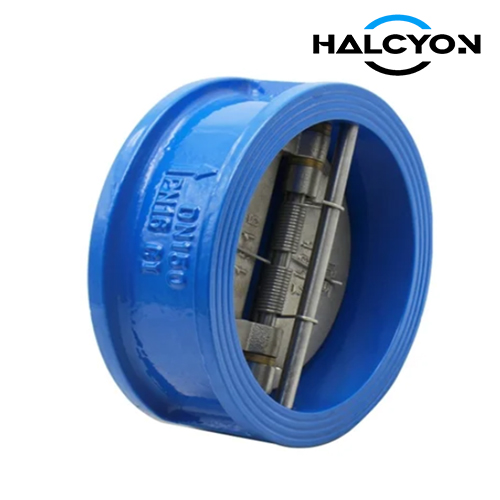
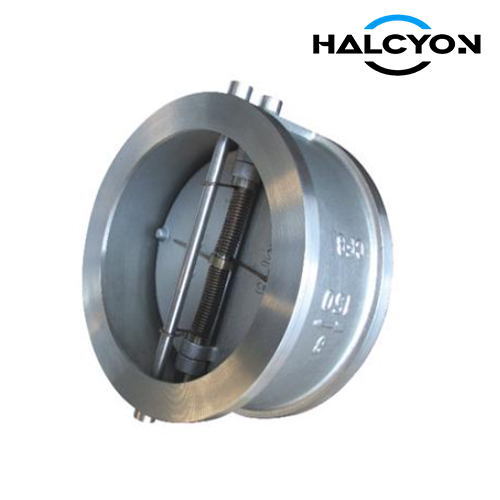
Wafer‑type – clamped between flanges, lightweight, and favourable for compression loading.
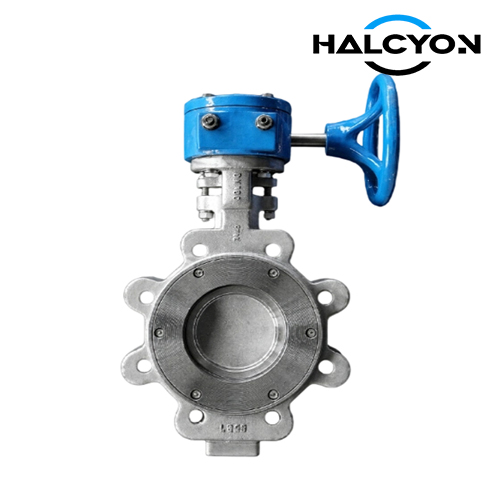
Lug and flanged versions – available for specific piping configurations.
Actuators include manual levers, gearboxes, electric motors, and hydraulic cylinders. Special variants: hydraulically controlled slow‑closing check valves (closing time 0.3–0.8 s) to suppress water hammer, and spring‑assisted quick‑closing emergency valves for fuel, steam, and gas lines.
Typical On‑board Applications
Ballast, bilge, cooling seawater, freshwater, fire‑fighting, fuel oil, lubricating oil, compressed air, exhaust, steam, and chemical cargo handling.