Male Marine Needle Valve
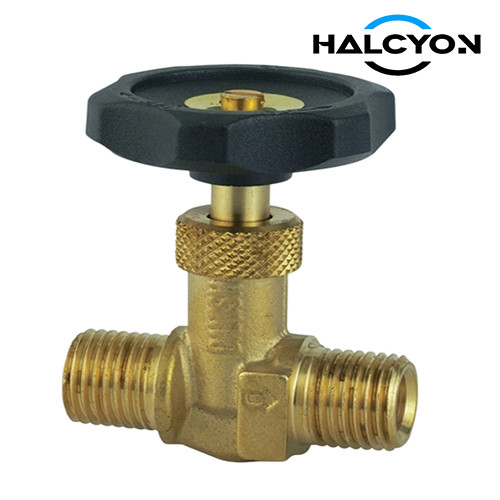
A Male Marine Needle Valve is a precision flow‑control device whose inlet and outlet ports are machined with external (male) threads. This configuration allows the valve to be screwed directly into female‑threaded pipe ends, manifolds, valve blocks, instrument panels, or flanged adaptors — eliminating the need for separate nipples, couplings, or unions. Internally, it employs a slender, tapered needle plunger that moves linearly into a precision‑matched seat via a fine‑pitch threaded stem. This provides exceptionally fine, repeatable flow regulation from a trickle to full flow, along with positive bubble‑tight shutoff when fully closed. Available in straight and angle body patterns, the male marine needle valve is the standard choice for direct mounting into instrument manifolds, burner fronts, hydraulic blocks, and gauge connections, combining installation simplicity with the precision and reliability demanded by critical shipboard systems.
Overview
1. Application
Male Marine Needle Valves are installed wherever precise flow adjustment, isolation, or dampening is required and where direct mounting into a female‑threaded component is preferred:
Instrument Panels & Manifolds: Directly screwed into gauge isolation manifolds, transmitter blocks, air supply panels, and hydraulic control manifolds. The male threads provide a rigid, permanent mounting point.
Fuel Oil Systems: Mounted directly into engine‑mounted fuel supply blocks for fine burner flow regulation; used on pilot lines and fuel recirculation circuits.
Lubricating Oil & Hydraulic Systems: Precision pressure regulation and isolation at hydraulic manifolds, gearbox lubrication blocks, and filter assemblies. The valve becomes an integral part of the block.
Compressed Air & Instrument Air: Point‑of‑use supply pressure regulation, mounted directly into pneumatic valve manifolds, actuator ports, and air tool connections.
Steam Systems: Steam tracing isolation and fine flow regulation, screwed directly into steam distribution manifolds and block assemblies.
Gauge & Transmitter Damping: Directly mounted between the process male connection and a pressure gauge or transmitter, providing both snubbing and isolation in one compact unit.
Fresh Water & Potable Water: Flow control in treatment plants and sampling lines, where a compact male‑threaded valve connects directly to female sockets in stainless steel piping.
2. Material Specifications
All materials are selected for proven compatibility with the intended shipboard fluid and the corrosive marine atmosphere, in accordance with applicable material standards (ASTM, EN, JIS):
Body & Bonnet:
Dezincification‑Resistant Brass (e.g., CW602N, CuZn36Pb2As): The standard for fuel, lube oil, compressed air, and freshwater services. Non‑sparking, inherently corrosion‑resistant, and requires no external coating.
Stainless Steel AISI 316L (1.4404 / CF8M): The premium choice for aggressive fluids, high‑pressure hydraulics, steam, chemical dosing, and hygienic applications. Provides lifelong immunity to pitting and crevice corrosion.
Duplex / Super Duplex Stainless Steel (UNS S32205 / S32750): For extreme‑pressure, warm seawater, and corrosive chemical injection services. Offers double the yield strength of 316L.
Male Threads: The external threads are precision‑machined integral to the body or as a separate threaded adaptor. They are manufactured from the same material as the body to ensure uniform corrosion resistance and strength.
Needle (Stem Tip) & Seat:
Precision‑lapped from hardened stainless steel (AISI 316, 17‑4PH) for smooth throttling and metal‑to‑metal shutoff.
Soft‑Seat Option: A replaceable insert of PTFE, PEEK, or reinforced FKM provides bubble‑tight, zero‑leakage closure (per EN 12266‑1 Rate A) for clean gases and liquids.
Stem & Packing:
The stem is stainless steel, with a precision‑rolled acme or metric trapezoidal thread to ensure smooth, backlash‑free adjustment and long packing life.
Gland packing is PTFE (standard for most services) or pure graphite (for high‑temperature steam and fire‑safe applications), compressed by an adjustable gland nut. Live‑loaded packing systems are available for maintenance‑free stem sealing.
Sealing Washers / Bonded Seals (BSPP male connections): For parallel male threads, a bonded metal‑elastomer sealing washer (dowty seal) or an O‑ring in a machined groove is supplied to ensure a leak‑free face seal when tightened into a female port.
3. Technical Specifications
Our Male Marine Needle Valves are designed, manufactured, and tested in strict accordance with the following international and marine standards:
Design & Manufacturing Standards:
BSPP (G‑thread, parallel): ISO 228‑1, with bonded seal or O‑ring groove.
BSPT (R‑thread, tapered): ISO 7‑1, for direct metal‑to‑metal sealing into female BSPT ports.
NPT (male tapered): ASME B1.20.1, for North American standard installations.
Metric (M): ISO 261 / DIN 13, for metric‑standard piping systems.
General Design: Principles of ASME B16.34 (Valves – Flanged, Threaded, and Welding End) and EN 13709 (Industrial valves – Steel globe and globe stop and check valves) are applied, adapted for the compact needle valve configuration.
Threads:
Fire‑Safe Design (optional): API 607 / ISO 10497 certified designs with graphite packing and a metal secondary back‑seat are available for fuel oil and flammable fluid lines per SOLAS Chapter II‑2.
Pressure Ratings:
Standard working pressures up to 400 bar (5800 psi) for stainless steel valves in small sizes.
Typical marine class ratings: Class 150, 300, 600, 800, 1500 (ASME B16.34 material group 2.2 or 2.3); PN16 to PN400 for DIN‑based systems.
Temperature Range:
With PTFE packing: ‑54 °C to +230 °C.
With graphite packing: ‑54 °C to +450 °C (subject to material pressure‑temperature derating).
Leakage Performance:
Metal‑seated: EN 12266‑1 Rate B or better.
Soft‑seated: EN 12266‑1 Rate A (zero visible leakage).
Testing & Certification:
Every valve is hydrostatically shell‑tested at 1.5× rated pressure and seat‑tested at 1.1× rated pressure per EN 12266‑1 or API 598.
Full EN 10204 Type 3.1 material certificates are provided for body, bonnet, stem, needle, and soft‑seat components.
Type approval or Certificates of Conformity from all major IACS classification societies can be supplied.
4. Dimension Specifications
The male‑threaded design ensures a compact, rigid installation directly into the mating female component:
Nominal Size Range (Male Thread Size):
Male thread sizes from 1/8″ (DN 6) to 2″ (DN 50) .
Corresponding pipe sizes are matched to the service flow and pressure requirements.
Thread Connection Standards & Configurations:
BSPP (G‑thread) Male: Parallel external thread with a flat sealing face for use with a bonded seal or O‑ring. Common designations: G¼", G½", G¾", etc.
BSPT (R‑thread) Male: Tapered external thread for metal‑to‑metal sealing into a BSPT female port. Designations: R¼", R½", etc.
NPT Male: Tapered external thread per ASME B1.20.1. Designations: ¼" NPT, ½" NPT, etc.
Metric Male: Parallel or tapered metric external thread per ISO 261. Designations: M14×1.5, M20×1.5, etc.
The precise thread type and size (e.g., "½″ NPT Male", "G½″ Male") is permanently laser‑marked on the valve body.
Body Pattern & Face‑to‑Face / Center‑to‑Face Dimensions:
Available in Straight (in‑line) and Angle (90°) patterns.
Compact dimensions are designed to fit standard instrument manifolds and control panels. For example, a typical ½″ NPT male straight needle valve has a face‑to‑face length of approximately 65–75 mm and an overall height of approximately 95–125 mm (depending on handle type). Exact dimensional drawings are provided in the product datasheet, and the footprint is fully interchangeable with industry‑standard male needle valves.
Handle & Operation:
Standard handle is a round knurled knob or a T‑bar for finger‑tight operation.
An optional locking nut or anti‑tamper cap prevents unauthorised adjustment.
For larger sizes and higher pressures, a heavy‑duty bar handle is supplied.
Installation Interface:
The valve body includes a hexagon (wrenching flats) dimensioned to standard spanner sizes for tightening the male threads into the female port.
For panel mounting, a male‑threaded bulkhead configuration with a locking nut is available on request.