ANSI Marine Angle Valve
The ANSI Marine Angle Valve is a quarter-turn body valve designed for reliable isolation and throttling service in shipboard piping systems. Manufactured to comply with ANSI/ASME specifications and major classification society rules, it changes flow direction by 90 degrees without a separate elbow, saving space, reducing welded joints, and lowering installation costs. Widely used in seawater cooling, ballast, fuel oil, steam, and compressed air lines, this valve offers long service life even under severe marine vibration and corrosion.
Overview
1. Governing Standards & Classification Compliance
Design & Dimensions: ASME B16.34 (Valves – Flanged, Threaded and Welding End), flange ends per ASME B16.5 (steel) or ASME B16.1 (cast iron), threaded ends per ASME B1.20.1 (NPT). Face-to-face dimensions follow marine practice or MSS SP-72 where applicable.
Class Society Approvals: Available with type approval certificates from ABS, Bureau Veritas (BV), DNV, Lloyd’s Register (LR), RINA, CCS, and others upon request.
Marking: Full traceable marking in accordance with MSS SP-25, including material grade, heat number, pressure class, and manufacturer identification.
2. Design Features
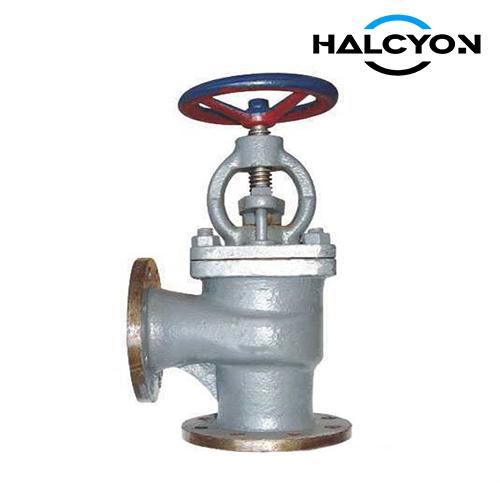
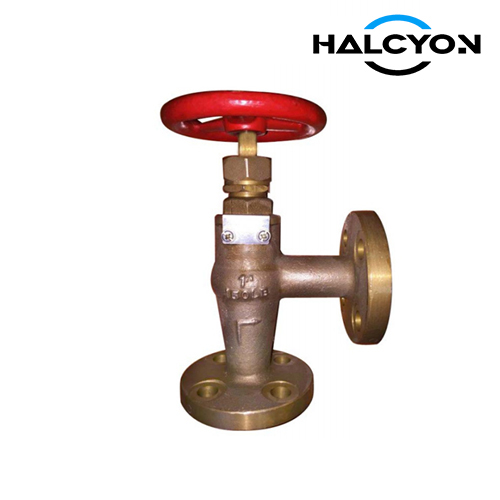
Angle Body Configuration: Single-piece 90° body eliminates one piping elbow, minimizing flow resistance and installation footprint.
Bonnet Type: Bolted bonnet for sizes 2″ and above (enables easy in-line maintenance); screwed bonnet for smaller sizes; both designs allow access to internal trim.
Renewable Seat & Disc: Hard-face or corrosion-resistant seating surfaces can be re-lapped or replaced without removing the valve body from the line.
Rising Stem with Acme Thread: Gives clear visual open/close indication; Acme thread form handles high operating thrust smoothly.
Backseat Arrangement: When fully open, the stem seals against a backseat bushing, preventing leakage at the stuffing box and permitting repacking under pressure.
Deep Stuffing Box: Multiple rings of PTFE or graphite packing, compressed by a gland flange, maintain a reliable stem seal during thermal cycling.
3. Materials of Construction
Materials are selected per ASTM specifications to suit the service medium:
Body & Bonnet: ASTM A216 WCB (carbon steel), ASTM A351 CF8/CF8M (stainless steel), ASTM B62/B584 C83600 (bronze), ASTM A536 (ductile iron), or ASTM B148 C95800 (nickel-aluminum bronze for seawater).
Trim (Seat/Disc): Bronze, 316 stainless steel, Monel, or resilient insert (Neoprene/PTFE for bubble-tight shut-off in water).
Stem: ASTM A276 Type 410 or 316 stainless steel, Monel for enhanced corrosion protection.
Gaskets & Packing: Graphite/PTFE suitable for high-temperature and fire-safe applications.
4. Pressure-Temperature Ratings
Rating Basis: ASME B16.34 Class, typically Class 150 or Class 300. (e.g., Class 150 WCB valve: MAWP 285 psi at 100°F, derating with temperature increase.)
Test Pressure: Shell test at 1.5× rated working pressure; seat closure test at 1.1× rated pressure, conducted per API 598 (or MSS SP-61). Optional low-pressure air seat tests available.
5. Quality Assurance & Certification
100% hydrostatic shell and seat testing on every valve.
EN 10204 Type 3.1 material certificates provided as standard; Type 3.2 available upon request with class society surveyor witness.
Positive Material Identification (PMI) and NDE (ultrasonic, dye penetrant) reports offered as optional documentation.
6. Typical Marine Applications
Seawater cooling, ballast, bilge, and fire-fighting mains.
Fuel oil transfer, lubricating oil, and thermal oil circuits.
Steam, condensate, and auxiliary boiler feedwater.
Compressed air, inert gas, and cargo system auxiliary lines.
Any location where space constraints demand a compact, elbow-free valve arrangement.
7. Key Advantages
Space-Efficient: Eliminates a separate elbow, reducing envelope dimensions in crowded engine rooms.
Robust for Sea Conditions: Proven resistance to ship vibration, dynamic loads, and corrosive salt-laden atmospheres.
Certification Ready: Full documentation package supports flag-state and classification society surveys, simplifying vessel commissioning.
Low Life-Cycle Cost: Renewable seats and backseat repacking capability minimize downtime and spare parts expense.